Bay Bridge, Ish’s Final Resting Place
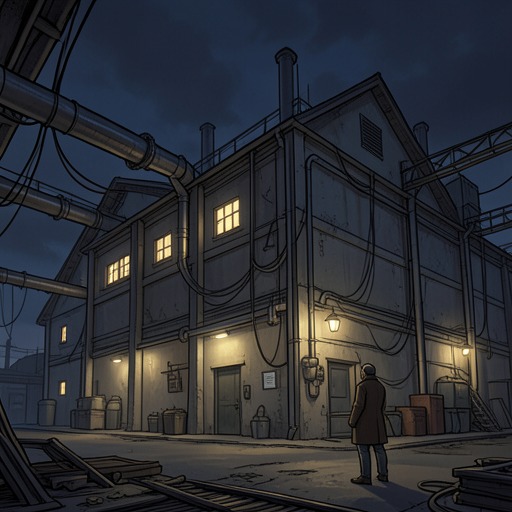
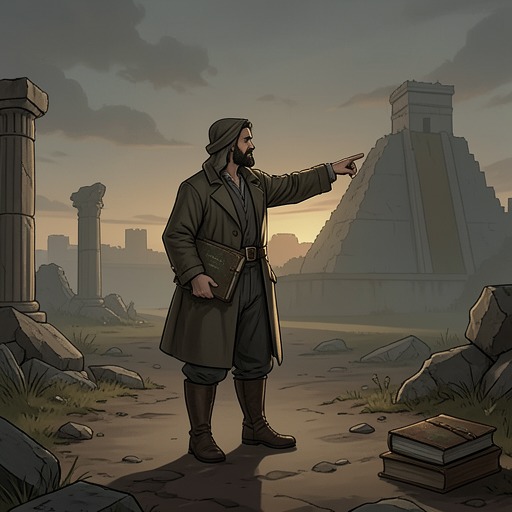
Earth AbidesThe Bay Bridge, Ish’s Final Resting Place is the deteriorating crossing Ish reaches near the end of his life, on a journey made by younger members of his community. It is at once a recognizable fragment of the world he remembers and a structure already being reclaimed by time: the road that once carried dense traffic has become a broken, hazardous passage. As Ish rests on its pavement, the bridge gives physical form to the endurance and eventual limits of human civilization.
Recognition and approach
During the morning’s march, Ish is carried on Jack’s back and repeatedly loses awareness of what is happening around him. When he focuses again, a shield-shaped road marker catches his attention. Its U.S. and California labels and the numerals 4 and 0 take him a moment to interpret; he has become so unused to seeing numerals that he must join them into the word forty. The marker lets him identify the overgrown route as old U.S. 40, the East Shore Highway, and infer that the group is heading toward the Bay Bridge.
That recognition reconnects the route to Ish’s memory of its former scale. He knows the highway as a six-lane road and recalls a time when traffic poured across the bridge in both directions, with cars moving so continuously that crossing on foot would have been dangerous. The young people approaching it have no direct access to that vanished traffic. For Ish, the bridge is therefore not simply a destination: it is a landmark through which the contrast between the Old Times and the present becomes concrete.
A crossing in decay
The bridge remains standing, but its intact outline conceals extensive damage. As the group climbs the long approach from the East Bay side, Ish sees rust across the structure, broken pavement, highway sections sagging, and some towers visibly out of alignment. The route is no longer a broad, continuous roadway. At one point, the travelers must cross a few feet on a single girder because it is the only passage available.
From Jack’s back, Ish looks down toward the water moving beneath the bridge. He notices that salt water has corroded the exposed metal, which is sagging and breaking. The scene sets two kinds of survival against one another: the bridge still spans the bay, but its material strength is being steadily reduced by exposure and neglect. Its condition makes the crossing an obstacle for the group even as it remains a monument to the engineering and infrastructure of the society that built it.
Ish’s last hours on the bridge
After another lapse in awareness, Ish comes to sitting on the bridge pavement beside the railing. His hammer lies in front of him, and Jack and another young man are trying to restore feeling to his hands. Two other young men remain nearby. Ish realizes that his feet and lower legs are cold and that what he has experienced is not merely one of his familiar lapses of old age: he believes he may have suffered a stroke or heart attack. The young people are disturbed by his condition.
Ish sees Jack moving his lips but cannot hear him. His loss of hearing does not distress him; he instead understands that the world will no longer press in on him through sound. The bridge is thus the setting not only for his physical collapse but also for a change in how he experiences the people around him. The four young men and the two dogs are present with him, yet his attention turns increasingly from them to the structure itself. The bridge becomes the last place from which he considers the world he is leaving.
A remnant with its own ending
As Ish looks beyond the young people, he feels more closely allied to the bridge than to them. It, too, belongs to the civilization that preceded their world. Nearby, a small coupé left on the bridge has weathered: its paint is almost gone, its tires are flat, its springs have weakened, and bird droppings cover its upper surfaces. The car offers a small-scale counterpart to the larger structure, another remnant that has persisted without remaining intact.
The bridge’s condition is not uniform. Ish sees that its tall towers and great cables retain their curves and appear better preserved than the roadway. The railings, towers, and cables are rust-colored, though he judges the rust to be superficial in those areas; the tower tops are white with generations of seagull droppings. He expects the structure may stand for many more generations, but not forever. Rust will work deeper, an earthquake may shake its foundations, and a storm may eventually bring down a span. The bridge’s survival is therefore real but provisional, just as human life and human creations are finite.
The bay and the surrounding hills place that forecast within a longer measure of time. Their profile has not changed since civilization’s destruction, and Ish recognizes the ridge’s twin peaks, which recall Em and, further back, his mother. In his final thoughts, landscape, family memory, and the old structure converge. The bridge has carried him to the edge of his life, but it also makes visible the larger passage from the society he remembers to a world the young travelers will inherit. It endures beyond the vanished traffic and the people who built it, yet its eventual failure is already contained in the corrosion and damage Ish sees.